
Stanford GSB’s “What Matters Most to You?” Essay… A Practical Guide to Getting it Right!
Every year I watch smart people spend six weeks looking for the right answer to Stanford’s first essay question. Six weeks. And the answer they land on is almost always the same handful of things: family, integrity, curiosity, service, my grandmother.
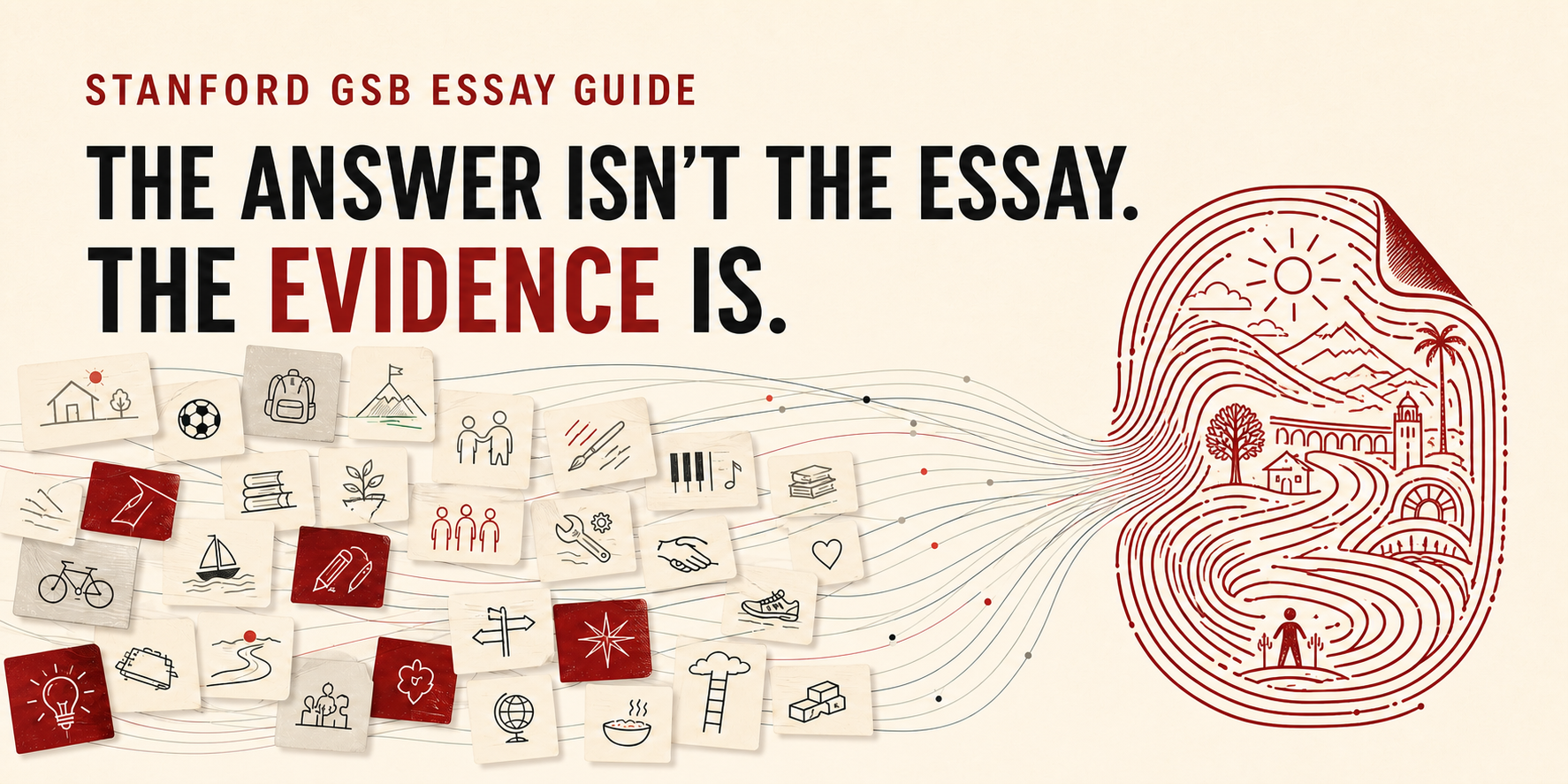
Here’s the part nobody tells you. That’s fine. The answer is not the essay.
Stanford has asked “What matters most to you, and why?” for well over a decade. If a distinctive answer were the point, they’d have retired the question years ago, because there is no distinctive answer left. Someone has already written the grandmother essay. Several thousand someones. The Admissions Office has read all of them.
What has not been read before is your evidence.
So let’s go through the 2026–27 application the way an admissions reader goes through it, and let’s be specific about what a strong draft actually does. If Harvard is also on your list, I walked through the HBS essay set separately.
The prompts, exactly as Stanford words them
Both prompts live on Stanford’s essays page, and they are worth reading in the school’s own words rather than in someone’s summary.
Essay A. What matters most to you, and why? Up to 650 words.
For this essay, we would like you to reflect deeply and write from the heart. Once you’ve identified what matters most to you, help us understand why. You might consider, for example, what makes this so important to you? What people, insights, or experiences have shaped your perspectives?
Essay B. Why Stanford for you? Up to 350 words.
Describe your aspirations and how your Stanford GSB experience will help you realize them. If you are applying to both the MBA and MSx programs, use this essay to address your interest in both programs.
Applying jointly to the MSx program adds a third essay: “How will you enhance the MSx community?” Most readers of this post won’t need it, but if you’re a joint applicant, don’t discover it in September. Stanford also notes that it “often” reads effective essays written in fewer words. Take that seriously. 650 is a ceiling, not a target, and there’s no reason to try to stuff a good 550-word essay with another 100 words of crap and fluff.
What actually changed this year?
The questions didn’t. Same two prompts, same 650 and 350. Two things did change around them. Stanford added an Application Essentials hub: videos, checklists, and notes from the Admissions Office on how to approach the application. Read it. It’s the school telling you what it wants, for free, and a startling number of applicants skip it in favor of forum speculation.
The second change is the one I’d underline. The essays page now spells out the difference between feedback and coaching, and it names tools as well as people:
It is improper and a violation of the terms of this application process to have another person or tool write your essays. Such behavior may result in denial of your application or revocation of your admission.
Or tool. Stanford wrote that down. More on that below.
Essay A: what the reader is doing with your 650 words
They are not grading your value system. Nobody at Stanford is going to decide that curiosity is a better thing to care about than loyalty.
They’re looking for three things, and the school is fairly open about it in its evaluation criteria: how you think, how you lead, and how you see the world.
First, whether the thing you say matters most actually shows up in how you’ve lived. Not in a summary sentence at the end. In the choices. I often tell clients that stories are the heart of a great essay, and your choices are the thing that helps you tell a great story. Did you turn something down? Take the harder job? Stay somewhere unglamorous longer than was good for your résumé? The claim is cheap. The evidence is the essay.
Second, whether you can think. A 650-word essay that moves from a specific scene to a general principle and back again is a demonstration of judgment and clarity of vision and purpose. That’s what business school is selecting for.
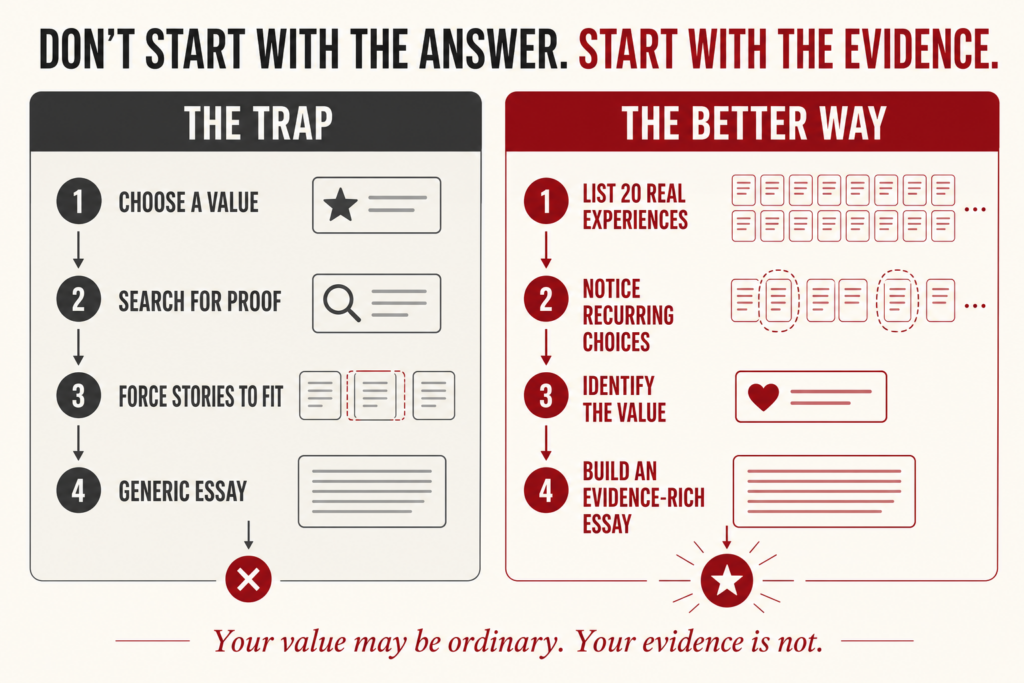
Which is why working forward from the answer fails. You pick “resilience,” and now you’re hunting for stories that prove resilience, and every story you find has been sanded down to fit. Work the other direction. Write down twenty things that actually happened to you, childhood included, embarrassing included, the ones you’d never put in an application, and then look for what keeps recurring. The theme you find that way will be truer and, weirdly, more specific, even if the label on it is ordinary.
Essay B: 350 words, and harder than A
Everyone assumes B is the easy one. It’s shorter, it’s concrete, it’s about your career.
It’s the one I send back most often.
Stanford asks for aspirations, not a career plan. That distinction wrecks people who’ve been trained on other schools’ goals essays, where you name the target function, the target firm, and the five-year path. Here, the question is closer to: what do you want to be different in the world, and what specifically about this place gets you there?
The failure mode is describing Stanford back to Stanford. Small class size, entrepreneurial ecosystem, proximity to the Valley. They know. Every one of those sentences is a sentence you didn’t spend on yourself.
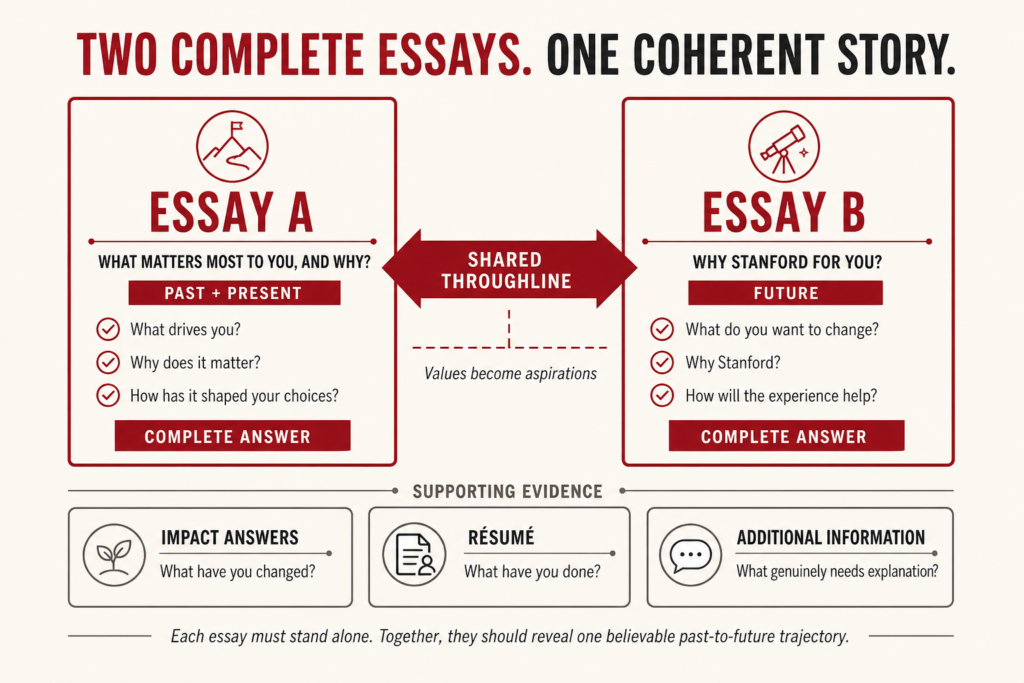
The other failure mode is worse and more common: an Essay B that has no relationship to Essay A. You spend 650 words on what matters most, then 350 words on a career that has nothing to do with it. A reader notices that gap immediately, and what they conclude is that one of the two essays isn’t true.
B should feel like the second half of A. A says what you care about and why. B says what you’re going to do about it and why you need this school to do it.
The optional short answer is not optional
Stanford gives you up to three examples, up to 1,200 characters each, roughly 200 words, about a time in the last five years you created significant impact. Situation, action, impact. The full wording is on the optional short answer page.
The word “optional” here is doing something specific. Stanford is telling you that if your contributions are already clear elsewhere, you’re done. In practice, for almost everyone, they aren’t clear elsewhere.
Write them. Situation, what you did, what changed. Include enough background that a stranger can tell why the outcome mattered, then be precise about your own role, because vagueness about your role reads as either modesty or dishonesty and readers can’t tell which.
Then there’s the additional-information box, which is for liabilities and gaps. A bad semester, a missing recommender, an anticipated promotion. It is not a fourth essay. Stanford says so directly, and using it as one is a small, avoidable way to signal that you don’t follow instructions.
The mistakes I see over and over
The abstraction essay. Six hundred and fifty words defending a virtue, with two illustrative examples dropped in. This reads like a commencement speech. Nobody remembers it by the next application.
The highlight reel. A list of accomplishments with a “what matters most” theme stapled on top. Your résumé already did this, and it did it better. You’re far better off telling one story well than trying to stuff your essay with a dozen mini-vignettes that you think will display your dazzling depth and breadth.
The trauma calculation. Applicants sometimes decide the essay needs to hurt, and go looking for the hardest thing that ever happened to them, whether or not it’s what matters most. Readers can feel the calculation. Write the true thing, not the heavy thing. As you’ve likely heard by now, the era of “trauma porn” personal statements has ended. Self-flagellation for its own isn’t the path to a winning essay. Optimism grounded in accomplishment is a better vibe to aim for. Yes, sometimes that accomplishment can flow from hardship, but your essay should always land on optimism and possibility.
The one-scene wonder. A beautifully written opening anecdote followed by 500 words of explaining what it meant. Trust the reader more, and see what actually makes an opening work.
Skipping the optional short answers because they say “optional.”
And the newest one: the smoothed draft. Someone writes an honest, lumpy, specific 700 words, then runs it through a tool to “tighten” it, and what comes back is competent and empty. Every odd turn of phrase gone. Every specific detail generalized. It hits every beat and it has no memory in it. I have read something like 15,000 of these essays since 2008, and the thing that has always separated the ones that work is the detail that a stranger could not have supplied. That’s exactly what smoothing removes.
Stanford’s own instruction is worth repeating: feedback means someone reads your finished essay and tells you what’s wrong, and afterward your thoughts, voice, and style remain intact. Coaching means someone else crafted part of it. The line isn’t blurry. It just requires you to notice when you’ve crossed it.
2026–27 deadlines
Applications are due at 4:00 p.m. Pacific Time on the deadline date. Stanford posts these on its deadlines page, and a completed application includes your letters of recommendation and the fee.
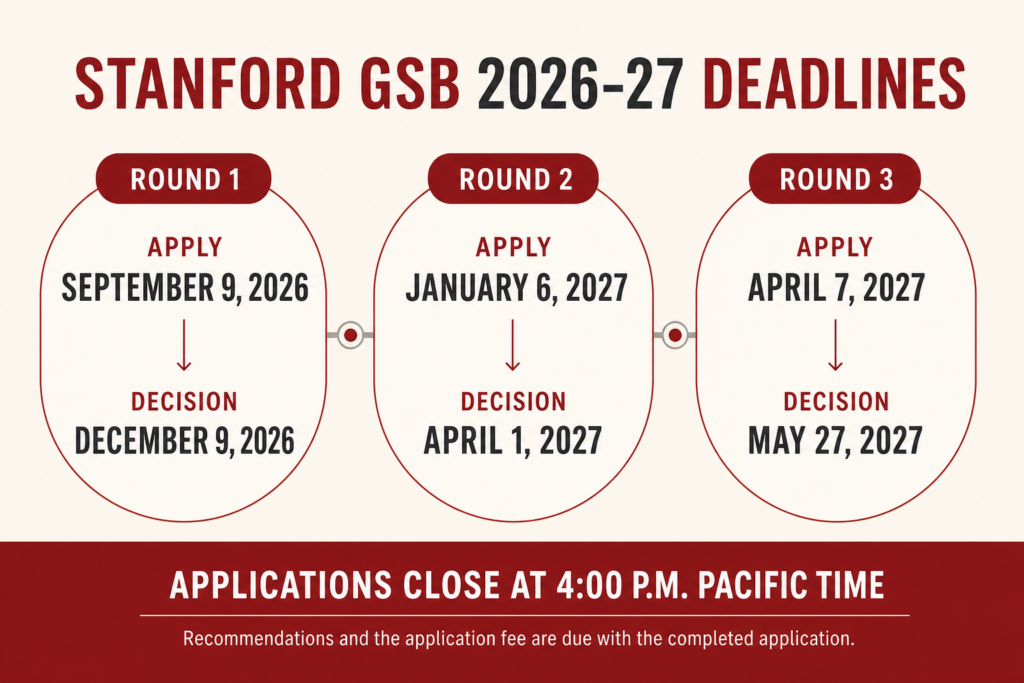
You may apply once per application year, in one round only. If you and a partner are both applying, Stanford encourages you to apply in the same round. If you’re aiming at deferred enrollment, you can apply in any round.
Round 1 is roughly six weeks out from this post. That’s enough time to do this well, and not enough time to start in late August.
Where to start today
Not with the essay. With the list.
Twenty things that actually happened. The good ones, the ugly ones, the ones from when you were nine. Don’t organize them. Don’t judge them. Then leave it alone for two days, come back, and look for what keeps showing up.
The answer you find will probably be ordinary. Family. Fairness. Building things. That’s fine. I told you at the top, the answer isn’t the essay. The four stories you use to prove it are the essay, and nobody else has those.
Gurufi has been editing admissions essays since 2008, roughly 15,000 personal statements for more than 7,000 applicants. Our editors are Ivy-educated, they’re human, and they don’t use AI on your work. What you get back is your essay, made better. If you want a real reader on your Stanford drafts, start here.
Official Stanford sources
Everything above is drawn from these pages.
- Essays: prompts, word limits, and the feedback-vs-coaching rule
- Deadlines for the 2026–27 application rounds
- Optional short answer question
- Application Essentials hub
- Evaluation criteria
- MBA entering class profile
- Letters of recommendation
- Interviews
- Deferred enrollment
- GMAC GME Admissions Reporting Standards, which Stanford follows in reporting its class profile
- mba.com








Leave a Reply
You must be logged in to post a comment.