
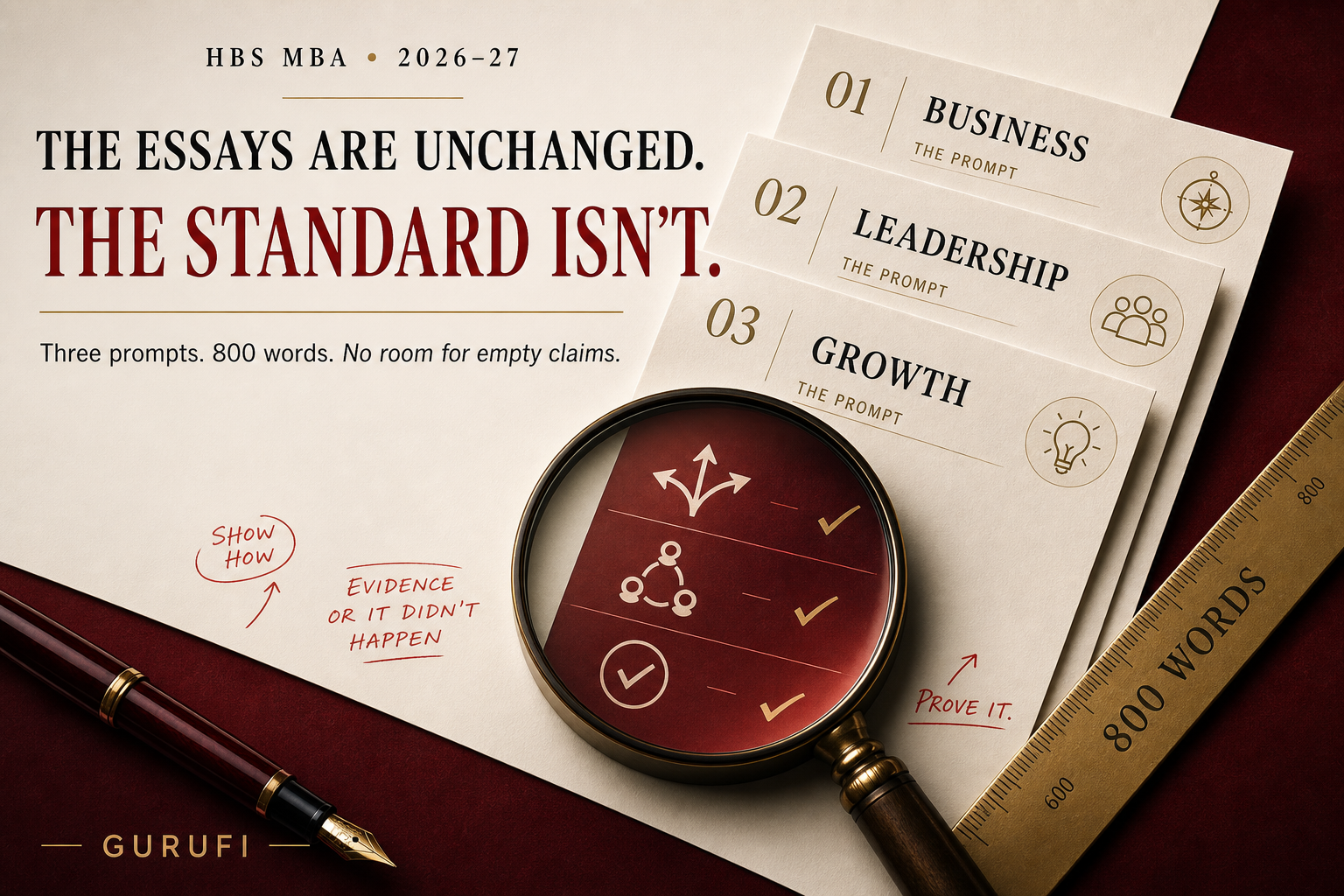
The HBS Essay Set Is Unchanged. Most Applicants Still Get It Wrong.
Harvard didn’t touch its MBA essay prompts this year. Same three questions, same word limits, second cycle running. Most applicants read that as good news.
It isn’t.
Stability means the Admissions Board has now read tens of thousands of answers to these exact prompts. Whatever counted as a fresh angle two years ago has been submitted a few thousand times since. The bar didn’t stay put just because the questions did.
(If you’re earlier in the process and still working out what an MBA essay is even supposed to do, read Mastering the MBA Personal Statement: From CV to Compelling Story first. This post assumes you’re past that.)
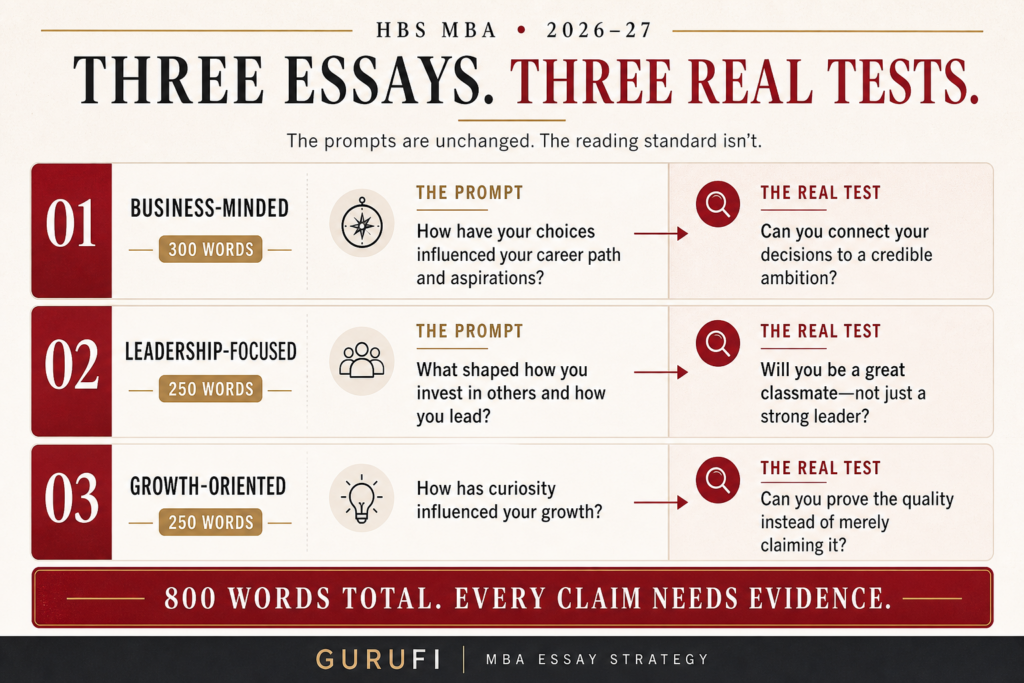
There is also a a 500-character career goals box, and 75 words of Additional Information that is not a fourth essay no matter how badly you want it to be.
That’s 800 words for the three core essays. Barely more than a Common App personal statement, and asked to do considerably more work. I’ve watched applicants look at that number and relax. Eight hundred words, they think. I can knock that out Sunday.
Sunday is where HBS applications go to die.
What each prompt is actually after
Essay 1: your choices, then your aspirations
Essay 1 has two halves that almost everyone collapses into one. Your choices, and your aspirations. The Board wants causation running between them. Not your résumé rewritten in paragraph form, because your résumé is already in the file and they’ve read it. One or two consequential decisions, why you made them, and the ambition those decisions produced. Three hundred words won’t hold a career survey. It will hold one fork in the road, rendered concretely, and a forward-looking claim specific enough that someone could check it.
If the fork you’re writing about is an industry switch, we’ve dealt with that problem at length in Navigating Career Transitions in Your MBA Personal Statement. The trap there is spending your word count justifying the departure instead of building the destination.
Essay 2: invest first, lead second
Essay 2 is the one people misread most often. Look at the ordering: how you invest in others comes before how you lead. That’s not an accident. HBS runs the case method in sections of roughly ninety people who spend two years learning from each other. The Board isn’t only underwriting a leader. It’s underwriting a classmate. So sketch the formative experiences fast, then land on one actual person you invested in and what changed for them. A name, a situation, an outcome. Then close on what that says about how you lead.
This is also where distance traveled belongs. First-gen applicants, bootstrappers, people who built something without a single institutional advantage — that story goes here, not buried in the Additional Information box like a footnote you’re embarrassed about. Much of what we say about writing a powerful diversity essay applies directly, because the failure mode is identical: gesturing at a background instead of showing what it cost and what it built.
Essay 3: prove the curiosity, don’t claim it
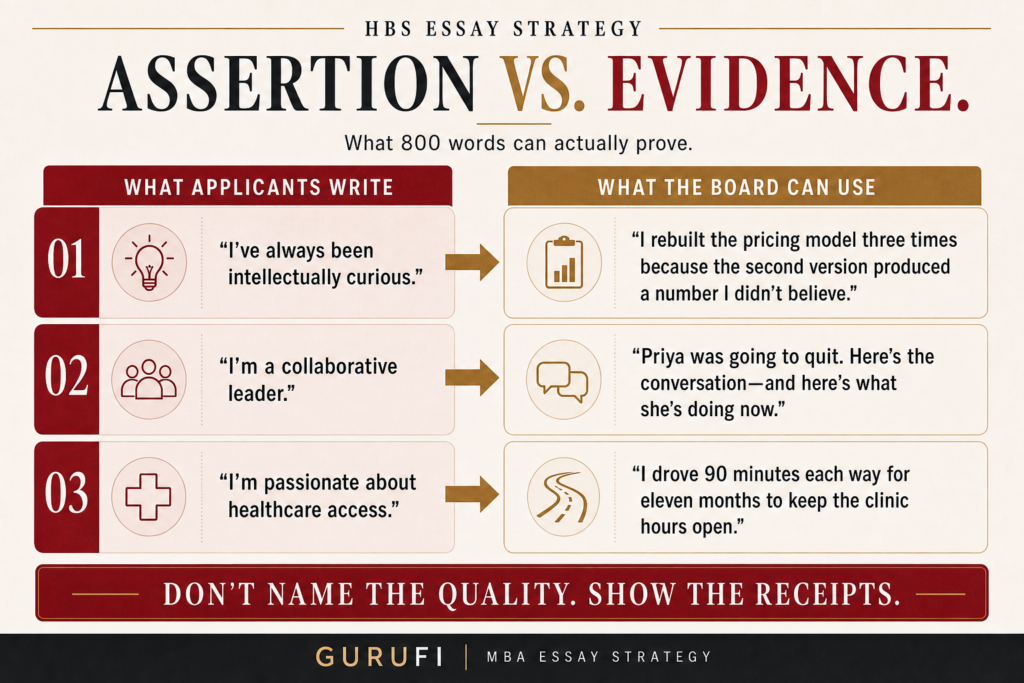
Essay 3 is the hardest, because curiosity is the easiest quality to assert and the hardest to prove. “I’ve always been intellectually curious” is not a data point. It’s a claim, and a weak one, and the Board has read it ten thousand times. What you did at 11pm on a Tuesday because you couldn’t stop chewing on a problem — that’s a data point. Situation, action, outcome, and the outcome should include what changed in you. Don’t spend any of your 250 words explaining why HBS is a great place for curious people. They know what they built. What they don’t know is what you do when you don’t understand something.
Here’s the difference, in the only terms that matter to a reader with four hundred more files to get through:
The mistakes I see over and over
Letting the career goals box contradict Essay 1
You’ll pick an industry and a function from dropdown menus, then get 500 characters to elaborate. The Board reads that box in immediate sequence with Essay 1 and expects the two to agree. When they don’t, it’s the single most common internal inconsistency in HBS files, and it’s completely avoidable.
Using Additional Information as an escape valve
HBS says plainly it’s for clarification. Seventy-five words of overflow essay tells the reader you couldn’t manage a constraint. The constraint is the test.
Writing three essays that could belong to three different people
They’re read together, as one document.
Not planning for the post-interview reflection
It’s required of everyone who interviews, due within 24 hours. Twenty-four hours is not enough time to figure out what you want to say. It’s barely enough to say it. Build the raw material during interview prep, not after — which is most of what we argue in Acing School Interviews.
Over-polishing until nobody’s home
And the quiet one. A great HBS essay sounds like a specific human being. An over-edited one sounds exactly like every other over-edited one. This usually happens because too many people have touched the draft, which produces what I’ve elsewhere called the Frankenstein Essay — competent seams, no pulse.
How a strong draft actually gets built
Start with inventory, not prose
Before you write a sentence of Essay 1, list every decision in your career a reasonable person would call a fork in the road, including the ones you’d rather not explain. That means:
- The job you took that confused everyone
- The promotion you turned down
- The lateral move that looked like a step backward
- The thing you started that failed
- The thing you quit
Your essay lives in one or two of them, and you can’t tell which until you see them side by side.
Draft long, then cut hard
I routinely see a strong 300-word Essay 1 come out of a 700-word first pass. Writing to the limit from sentence one produces summary. Writing past it and cutting produces selection, and selection is where voice comes from.
Read all three aloud in one sitting
Read them as a single document. If any one of them could be dropped into another applicant’s file without anyone noticing, it isn’t finished. This is the most useful exercise almost nobody does.
Test every claim
For each sentence asserting a quality — curious, collaborative, resilient — ask whether the surrounding text would let a stranger reach that conclusion on their own. If yes, delete the assertion. You already earned it. If no, replace the assertion with the evidence.
Reverse-engineer the reader
When the Board closes your file, they’ll hold one or two sentences about you in their heads. Write those sentences down before you draft. Then check whether your essays would actually produce them.
A note on deadlines
HBS currently lists Round 1 as September 2026 and Round 2 as January 2027, with specific dates circulating on applicant forums but not yet confirmed on the official page. Plan around the forum dates, verify on hbs.edu before you build a calendar on them.
Before you submit: the eight-hundred-word checklist:
Frequently Asked Questions
The prompts didn’t change. Can I reuse last year’s essays?
You can. I’d rather you didn’t. Reapplicants get read against their previous file, so an unchanged essay tells the Board that nothing happened to you in a year — which is a worse answer than any of the three prompts asks for. Start from the same raw material if you like, but the decisions you’ve made since the last submission are the most interesting thing you now have.
How long are the HBS essays for 2026-27?
Three hundred words for Essay 1, 250 each for Essays 2 and 3. Eight hundred total, plus a 500-character career goals box and 75 words of Additional Information.
What actually belongs in the 75-word Additional Information section?
Clarification. A gap in employment, a grade that needs context, an unusual transcript, a testing situation. Not a fourth essay, not the story you couldn’t fit into Essay 2, and not a restatement of why you want the degree.
When is the HBS post-interview reflection due?
Within 24 hours of your interview, submitted through the application system, and it’s required of everyone who interviews. Prepare for it before you interview, because a day is not enough time to decide what you think.
What eight hundred words can do
Eight hundred words isn’t much room to be understood. It’s exactly enough room to be understood well, if the right eight hundred survive the cutting.
Gurufi has spent fifteen years helping applicants find those words. Every editor on our team was educated at an Ivy League institution and has done this level of writing themselves, which is why our edits sharpen a voice instead of sanding it down. You can see how our editing process works, meet the people who’d be reading your drafts, or go straight to MBA essay editingif you want trained eyes on your HBS essays before Round 1. We’re at gurufi.com.
At Gurufi, we believe the best admissions essays do more than summarize accomplishments. They reveal the experiences, motivations, and values that make you unique. For nearly two decades, our team of expert editors has helped applicants craft powerful personal statements for college, MBA, medical school, law school, graduate school, and other competitive programs.
Learn more about our admissions essay editing and consulting services: https://www.gurufi.com/
Learn more about our story and approach: https://www.gurufi.com/about/
Have questions about your application? Contact us here: https://www.gurufi.com/contact/
For more admissions insights, essay advice, and application strategies, follow Gurufi:
YouTube: https://www.youtube.com/@gurufi LinkedIn: https://www.linkedin.com/company/guruficonsulting Facebook: https://www.facebook.com/gurufi X/Twitter: https://twitter.com/gurufinder
Your experiences matter. Your story matters. Make sure admissions committees understand both.








Leave a Reply
You must be logged in to post a comment.